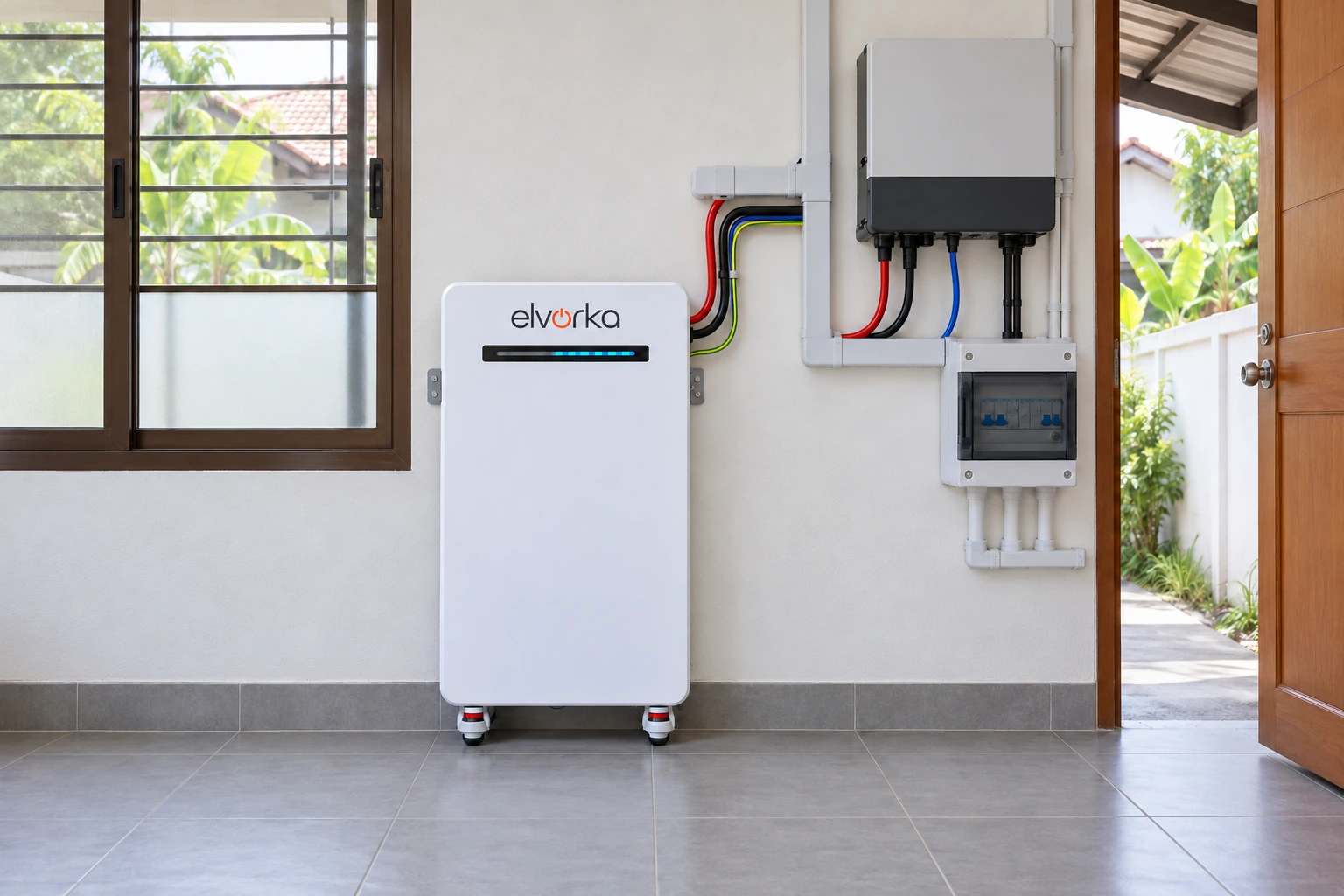
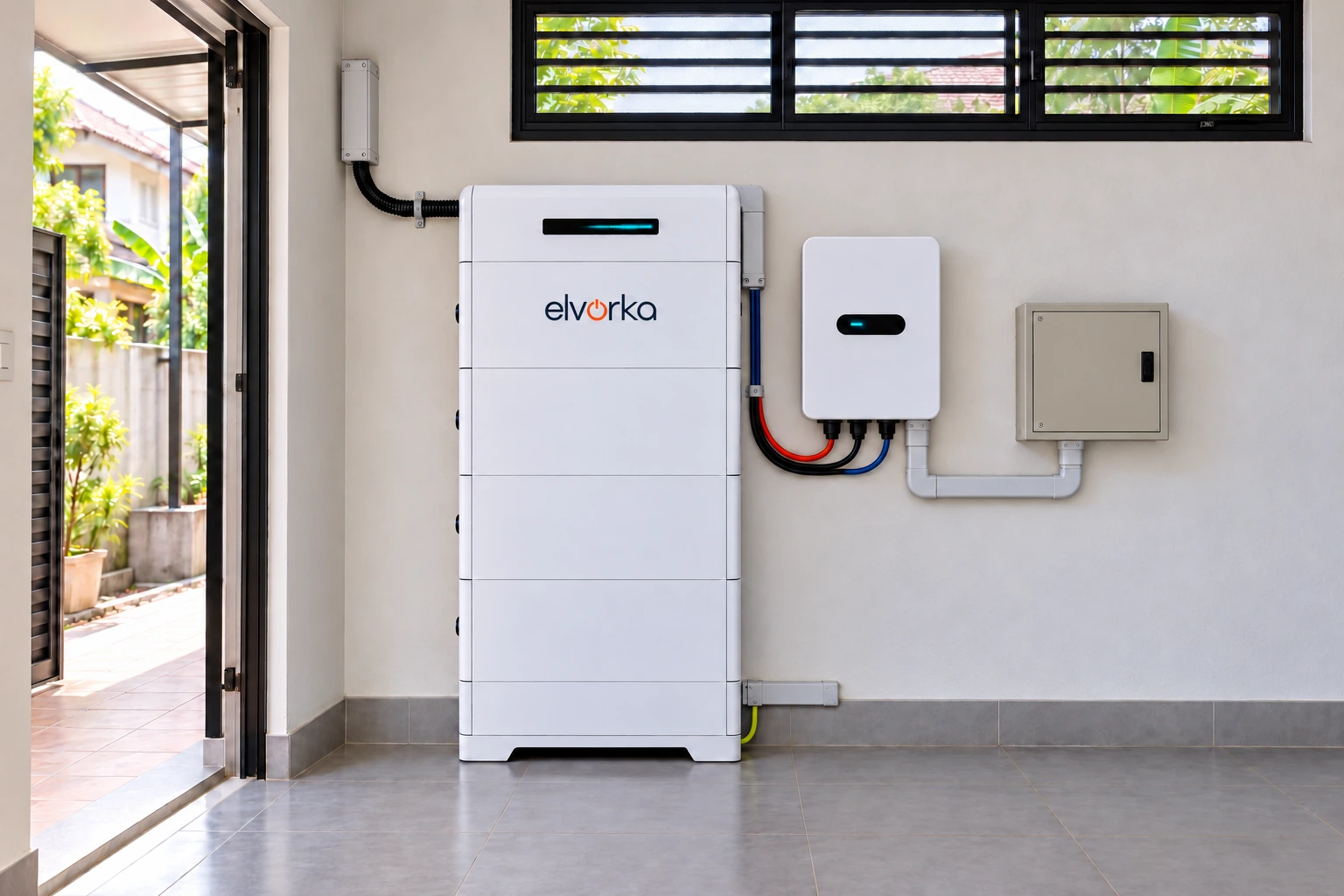
A dry utility room, a seasonally hot garage and a coastal service area place different demands on equipment. Assess conditions where the battery will stand, including the coldest and hottest periods. The following local profiles help frame the questions; they do not certify a particular installation.
A hot enclosed room, a rain-exposed southern home and a northern cool-season location need different checks. Localize the installation plan around the battery's real environment, not a single label for Thailand.
Choose for the room, the season and the region.
Central home · heat in the equipment room
An enclosed utility room can have different conditions from outdoor weather; assess the actual room.
An EU all-in-one needs a location consistent with its IP21 enclosure and model manual. Preserve ventilation and service access. Its listed charge 0 to 55 °C range is not a guarantee of full-power operation in a sun-heated or unventilated space.
Questions for your installer
- Does the room collect roof or afternoon heat?
- What temperature is observed at the battery position during use?
- Can equipment clearances and ventilation stay unobstructed?
Southern home · monsoon exposure
Southern rainfall patterns differ from the north; the southeast can remain rainy under the northeast monsoon.
Plan a dry, sheltered equipment area and evaluate rain entry, coastal air and water exposure at the actual site. TR Pro and HP Ultra list IP66, but no salt-spray or flood guarantee is established by the reviewed product literature.
Questions for your installer
- Can rain or splash reach the equipment area?
- Is there coastal or salt-air exposure?
- Which sheltered position is accessible for inspection and service?
Northern home · seasonal temperature change
The northeast monsoon brings cooler, drier conditions to much of northern and northeastern Thailand.
Record the actual low temperature and any damp or condensation exposure at the chosen location. Check the selected battery's charging limits; optional self-heating must be confirmed for the exact model rather than assumed to enable sub-zero charging.
Questions for your installer
- What is the lowest temperature at the battery location?
- Is damp or condensation seen during seasonal changes?
- Which inverter voltage and communication interface does the system require?
Planning notes
- Keep the inverter relationship clear: an EU or TA6000 all-in-one includes an inverter; an HP, TR or TB battery-only installation requires a compatible external inverter.
- Do not transfer climate limits across families. TR Pro lists charge 0 to 55 °C and discharge −20 to 60 °C; HP Ultra's selected configuration temperature limits need confirmation.
- Separate enclosure selection from climate assumptions. EU is IP21; TR standard and HP K list IP20 with optional IP54, TB is IP20, and TR Pro / HP Ultra list IP66. Confirm shelter, damp exposure and model-specific installation requirements.
Keep charging and discharging limits separate
The TR Pro literature lists charging at 0–55 °C and discharging at −20–60 °C. The colder discharge boundary is not permission to charge below zero. Self-heating is optional and must be confirmed for the exact configuration. HP Ultra temperature limits require configuration confirmation; do not transfer another family's limits to it.
Read the views, then request the exact manual
The technical library retains the original product views and numbered interface labels. A visible connector is not enough to infer a pinout, polarity or power rating. Confirm the selected model's wiring diagram, protection, cable requirements, clearances, torque values and communication settings from its installation documentation. The scene illustrations are visual references, not wiring instructions.
Record the proposed room, expected temperatures, moisture exposure and maintenance access. For an integrated system, confirm the required AC configuration. For a battery-only system, include the existing inverter model and DC voltage range in the brief.
Questions for your installer
Is a higher IP rating enough for a Thai rainy-season location?
No. Use the selected model's installation manual and the actual site's rain, splash and moisture exposure. The reviewed literature does not establish unrestricted outdoor, flood, condensation or salt-spray suitability from IP66 alone.
Can these backup examples include air conditioning?
The example circuits intentionally exclude air conditioning. Add your unit's actual running power, compressor starting requirement and target duration to a separate load plan, then confirm both the battery configuration and inverter capability.
Which site details make the quotation more useful?
Provide the region, proposed equipment area, observed temperature range and rain or damp exposure, plus the existing inverter model and essential circuits. Confirm the exact configuration, installation scope and availability with the supplier.